
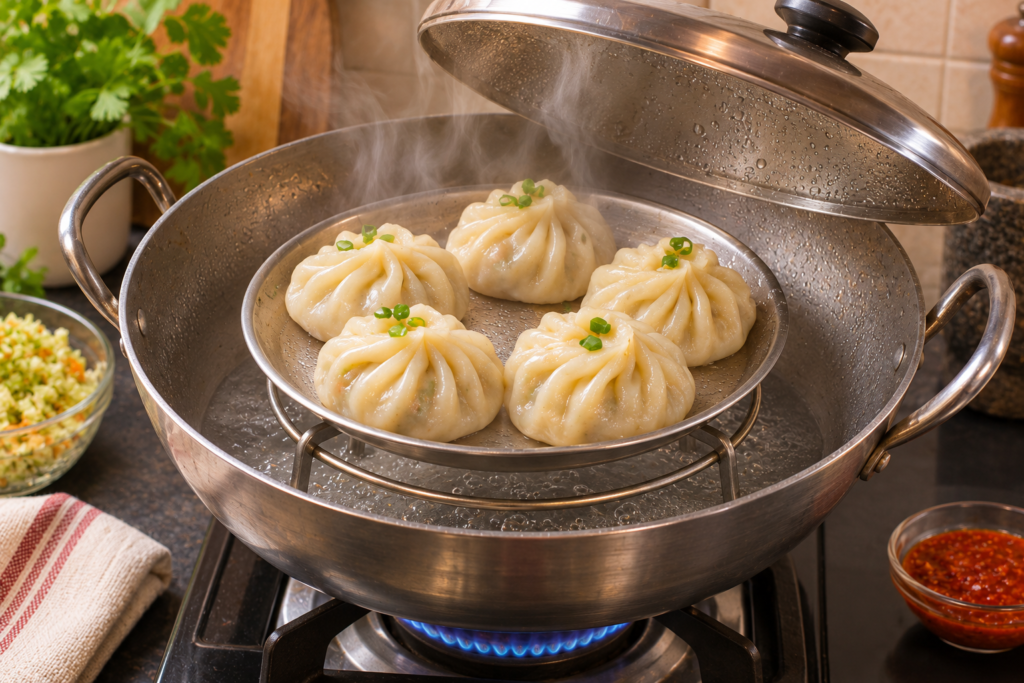
No bamboo steamer or electric momo steamer? You can steam vegetarian momos in a deep kadai, ordinary lidded pot or compatible idli-steaming setup. The key is to keep the dumplings above simmering water so hot steam—not boiling water—cooks the wrappers and filling.
Quick answer: Set a stable, heat-safe stand in a deep pot or kadai, add water below the level of a perforated steaming tray, bring the water to a steady simmer, arrange momos with space between them and cover. Begin checking thin-wrapper, small vegetable momos after roughly 7–10 minutes of active steaming, but adjust for their size, wrapper thickness, filling and equipment. There is no universal safe cooking time.
Editorial note: This is a research-based equipment guide compiled for home cooks, not a kitchen-tested Momo Crown experiment. The featured image is illustrative. Make sure the utensils you use are stable, heat-safe and suitable for steaming.
At a Glance: Steam Momos in a Kadai or Pot
| Best for | Small, freshly prepared vegetarian momos |
|---|---|
| Basic equipment | Deep kadai or pot, fitted lid, sturdy metal trivet, heat-safe perforated plate or steaming insert, tongs |
| Water level | Below the bottom of the momo tray; it must not boil up onto the momos |
| Timing | Start checking around 7–10 minutes for small fresh veg momos, then continue as needed; thicker or larger pieces may take longer |
| Doneness | Wrapper cooked through, not pasty or raw, filling properly heated and cooked |
| Caution | Never seal an improvised pressure vessel or block a pressure-release vent |
- Choose a stable deep pot with a properly fitting lid.
- Add a few centimetres of water, keeping it below the raised tray.
- Insert a secure trivet and heat-safe perforated plate; verify that nothing wobbles.
- Bring water to a steady simmer. Lightly grease the tray and space the momos apart.
- Cover and steam. Check doneness rather than relying on minutes alone.
- Lift the lid away from your face; remove momos with tongs and serve.
How Steaming Works When You Do Not Own a Steamer
Steaming transfers heat from hot water vapour to the food inside a covered vessel. A purpose-built steamer combines a water chamber with an elevated tray, but a suitable household pot can do the same job if its parts are safe and stable. Direct contact with water makes momos boil rather than steam, potentially softening or breaking their wrappers.
The practical requirements are a steady water supply, enough clearance under the tray, an appropriate path for steam and a lid that retains moisture without creating dangerous pressure. Unlike pressure cooking, a makeshift kadai steamer should operate as a normal, non-pressurized covered pot.
Method 1: Steam Momos in a Kadai (No Dedicated Steamer)
Step 1 — Select a kadai deep enough for a raised tray
Choose a heavy, heat-safe kadai with enough depth for simmering water, a trivet and a tray without the lid touching the momos. A round-bottom kadai needs particular care: the support must sit securely and must not tilt when loaded. If a plate rocks or slides, do not use that arrangement.
Step 2 — Add water below the tray
Pour in enough water to simmer for the anticipated cooking period, but not enough to touch or splash the food. The exact volume depends on your vessel. Check that the tray stays above the water even when it boils gently. Do not allow the pan to boil dry.
Step 3 — Position the trivet and perforated tray
Use a stable metal steaming rack or properly compatible insert. A perforated tray lets steam circulate underneath each momo; if you use a non-perforated heat-safe plate, steam access is less even and cooking may take longer. Do not use plastic items, unstable overturned containers or materials that might shatter in heat.
Step 4 — Start steady steam and arrange the momos
Bring water to a simmer, lightly grease the steaming surface or use suitable food-safe liners, and arrange the momos with gaps so they do not fuse together. Close the lid. Avoid lifting it repeatedly, since doing so releases steam and changes the cooking time.
Step 5 — Check doneness before serving
Start checking small, thin-wrapper vegetable momos after roughly 7–10 minutes of steaming once the water is producing steam. Thicker wrappers, larger momos, an improvised plate without holes or a weaker stove may take longer. Carefully cut one open: there should be no raw dough in the pleated base or centre, and the filling should be thoroughly cooked. For fillings with raw poultry, use a food thermometer and ensure the centre reaches 74°C (165°F); visual appearance alone cannot establish safety.
Burn prevention: Condensation and steam are hot. Open the lid away from your body and use long-handled tongs or heat-resistant gloves.
Method 2: Steam Momos in an Idli Stand
An idli steaming stand may be the simplest alternative for many Indian kitchens. Put the required water in the idli vessel, grease the moulds or appropriate surfaces, place momos without crowding and cover according to the appliance’s instructions. The narrow mould shape can constrain the momo, so avoid very large pleated dumplings that touch each other or the lid.
If the idli stand is designed to fit into a pressure cooker, use only the steaming configuration approved by that cooker’s manufacturer. Do not improvise removal, sealing or modification of safety mechanisms. When the manufacturer’s instructions are unclear, use an ordinary lidded pot instead.
Method 3: Use an Ordinary Deep Pot
A deep saucepan or stockpot may be easier to stabilize than a curved kadai. The same principles apply: water below a sturdy raised insert, a fitted lid, an appropriately greased steaming surface and steady steam. The pot method is especially useful when you already own a compatible stainless-steel steamer basket or colander that fits securely above the water and under the lid.
Do not suspend a colander precariously across a pan rim where it can slip. Keep handles away from children and verify that the lid fits safely.
Can You Steam Momos in a Pressure Cooker Without a Steamer?
Some home-cooking articles describe using a pressure-cooker body with an idli stand or raised plate. However, pressure cookers have safety systems that differ by model. We do not recommend converting one by blocking vents, forcing an unsuitable lid arrangement or removing components contrary to the manufacturer’s directions. If your pressure cooker has a documented steaming mode and approved basket, follow that manual. Otherwise, choose a regular kadai or pot with a non-sealing lid.
How Long Should Momos Steam?
There is no single correct number. Published vegetarian recipes suggest different timings: Dassana’s Veg Recipes describes approximately 5–7 minutes for thin, freshly made momos in its setup, while other household steaming guides describe longer times in improvised steamers. This difference is one reason a broad “exact steaming time” claim would be misleading.
| Situation | How to approach it |
|---|---|
| Small, fresh vegetarian momos with thin wrappers | Begin checking around 7–10 minutes once steaming has begun; continue until fully cooked |
| Larger momos or thick pleated bases | Allow additional time and inspect the centre of a sample |
| Frozen momos | Start from the product’s cooking instructions when provided; heat through completely without relying on a fresh-momo time |
| Raw chicken-filled momos | Use a food thermometer to verify 74°C/165°F in the centre, not simply a time estimate |
A wrapper that looks glossy or translucent can be a helpful visual cue, but it does not prove that an internal meat filling has reached a safe temperature. Cooking from frozen, the number of pieces in the tray, wrapper thickness and lid fit can all affect time.
Troubleshooting Common Problems
Why do my momos stick to the plate?
A dry, flat plate encourages sticking. Lightly grease the tray, allow space between pieces and avoid leaving finished momos cooling on a wet surface for a long time. Use compatible perforated liners if you have them; do not cover all steam holes with non-permeable material.
Why are the momos hard or chewy?
Possible causes include dough rolled too thick, uncovered dough drying before pleating, or longer cooking than necessary. The fix begins before steaming: allow dough to rest, roll evenly and keep unused dough covered. See our planned soft momo dough troubleshooting guide when the related draft is published.
Why are they wet and soggy?
The water may be touching the tray, the pan may be boiling violently, or condensed water may be dripping heavily from the lid. Reduce boiling intensity and maintain the correct water level. A little condensation is normal.
Why is the filling still cold?
Starting with frozen or refrigerated dumplings, overcrowding the tray or poor steam circulation can delay cooking. Continue cooking until the filling is fully heated and check the centre. Use a thermometer for meat or poultry fillings.
What if my pan runs out of water?
Turn off the heat and let the setup cool enough to handle safely. Do not pour cold water into a very hot dry pan or continue heating the empty vessel. For the next batch, use a larger water reservoir within the safe clearance under the rack.
Safety Rules That Matter More Than the Clock
- Use equipment designed to withstand direct kitchen heat; keep the tray stable and above the water.
- Open steaming vessels away from your face and hands to avoid hot steam burns.
- Do not use pressure-sealing or valve-blocking shortcuts in an improvised steaming setup.
- For raw chicken filling, verify 74°C/165°F with a food thermometer. The US FDA publishes this safe minimum temperature for poultry.
- Clean utensils that touched raw fillings before using them for cooked momos; avoid raw-to-cooked cross-contact.
- Serve promptly or refrigerate perishable cooked food at 4°C or below within two hours (one hour when the environment exceeds 32°C).
Frequently Asked Questions
Can I steam momos in a kadai without a cooker?
Yes. A stable rack and raised tray inside a deep, covered kadai can steam momos when water remains below the food. A purpose-made rack is safer than improvised unstable supports.
Do I need to add oil to the boiling water?
No. The sticking problem happens at the tray rather than in the boiling water. Lightly grease the food-contact surface if appropriate.
Can I use an idli maker for momos?
Yes, if it has enough clearance and a suitable steaming tray or mould. Follow the idli maker’s instructions and don’t crowd the momos.
Can I microwave momos to steam them?
A microwave-safe steaming accessory may work if its manufacturer gives a suitable procedure, but a plain plate under a random lid does not reproduce conventional steaming consistently. Follow device-specific instructions and verify the filling is cooked.
Is a pressure cooker necessary?
No. A normal covered pot often offers a simpler non-pressurized solution.
What sauce goes with steamed vegetable momos?
A spicy tomato–chilli dip is common. For a no-onion, no-garlic variation, see our garlic-free momo chutney guide after the connected recipe draft is published. You can also explore the Momo Crown menu for dumpling varieties.