
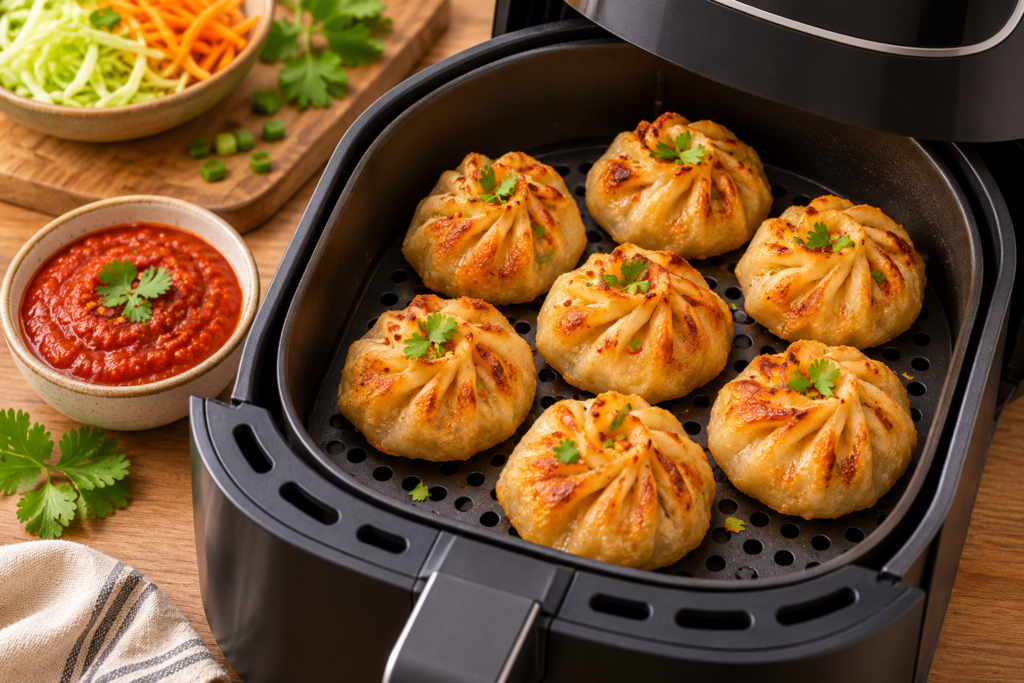
Can you make crispy momos in an air fryer without deep-frying? Yes, especially when you begin with already cooked momos. A light coating of oil and circulating hot air can crisp the outside. The important caveat is that air-fryer momos are not steamed momos: hot moving air can also dry out a delicate wrapper if the temperature or time is wrong.
On this page
Quick answer: Start with 8–10 small, fully cooked vegetable momos, lightly brush with oil, put in a single layer and use 180°C as a trial temperature. Check after about 5 minutes, turn carefully and continue only until lightly golden and properly hot. Published recipes report different totals, and the correct time depends on your air fryer and the momos. This is a starting method, not a guaranteed tested setting.
Jump to air-fryer instructions
Air Fryer Momos: Quick Recipe for Already-Cooked Veg Momos
For: A small batch of fully cooked veg momos. Prep: A few minutes. Trial temperature: 180°C. Trial cooking check: Start assessing at approximately 5 minutes; continue in short increments as needed. Safety: The filling must already be cooked and heated through at serving.
Ingredients
- 8–10 small fully cooked steamed vegetarian momos (fresh or properly chilled)
- 1–2 tsp neutral cooking oil, or a light even spray, depending on batch size
- Optional pinch of chilli powder or black pepper
- A dipping sauce to serve separately
Method
- Check that the momos are fully cooked and intact. If refrigerated, keep them cold until preparation.
- Preheat the appliance if the manufacturer recommends preheating. Set it to around 180°C as an initial trial.
- Brush a thin film of cooking oil over the momos; do not soak them.
- Place them in one layer with small gaps so hot air can circulate. Use only accessories your appliance approves.
- Air-fry, checking at about 5 minutes; flip gently and cook further until lightly browned and hot throughout.
- Remove carefully with tongs and serve promptly. Avoid allowing a very dry wrapper to keep cooking just to reach a specific colour.
Important: The trial above is not suitable as a blanket rule for raw chicken-filled momos or uncooked frozen products. Use the food manufacturer’s directions and verify appropriate internal temperatures.
What Does an Air Fryer Actually Do to Momos?
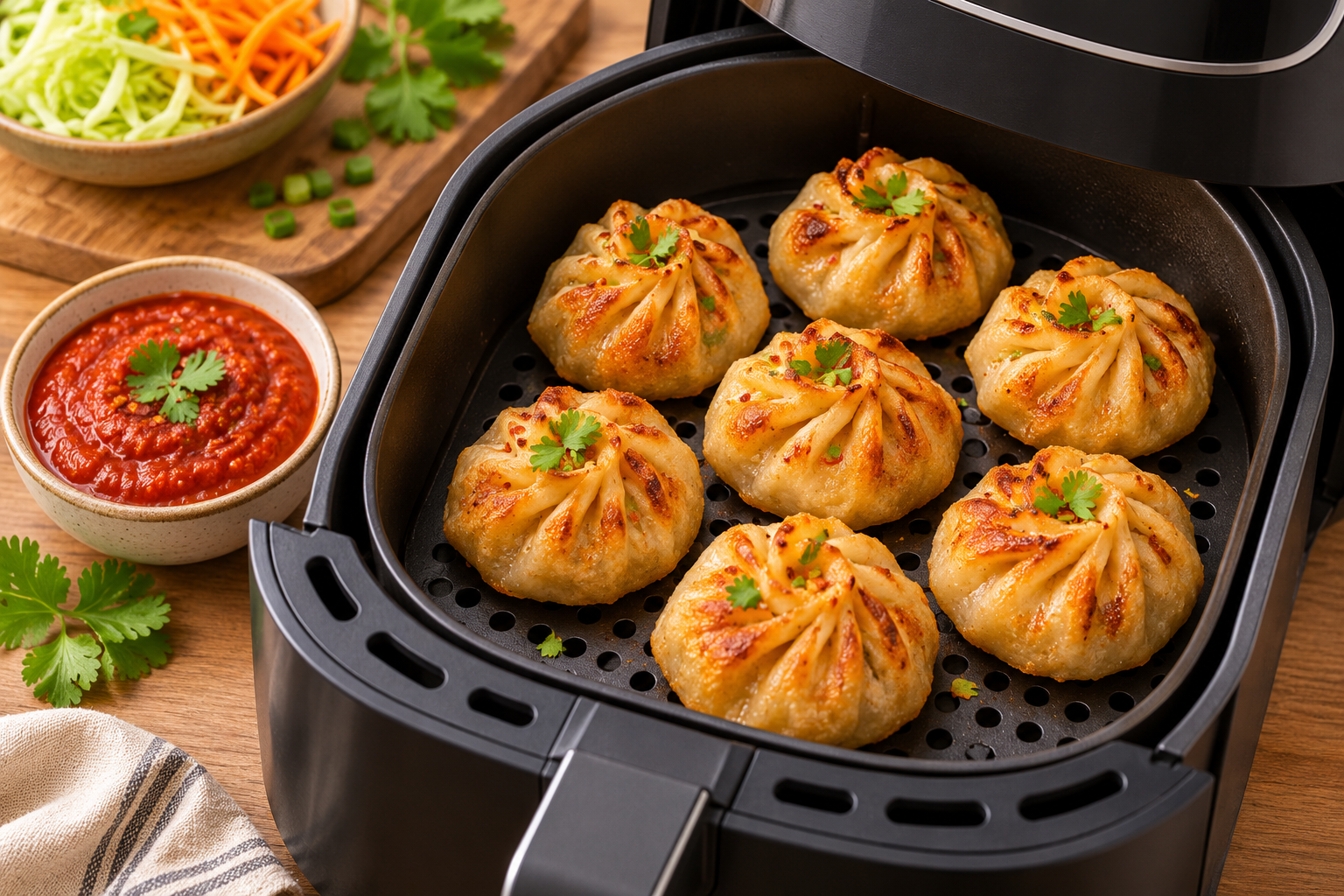
A basket air fryer moves heated air around the dumplings. It can brown a pre-cooked wrapper and produce a more crisp surface with substantially less loose oil in the cooking chamber than deep frying. That does not automatically mean identical taste or a specific reduction in calories: the filling, amount of applied oil, sauce and serving size all matter.
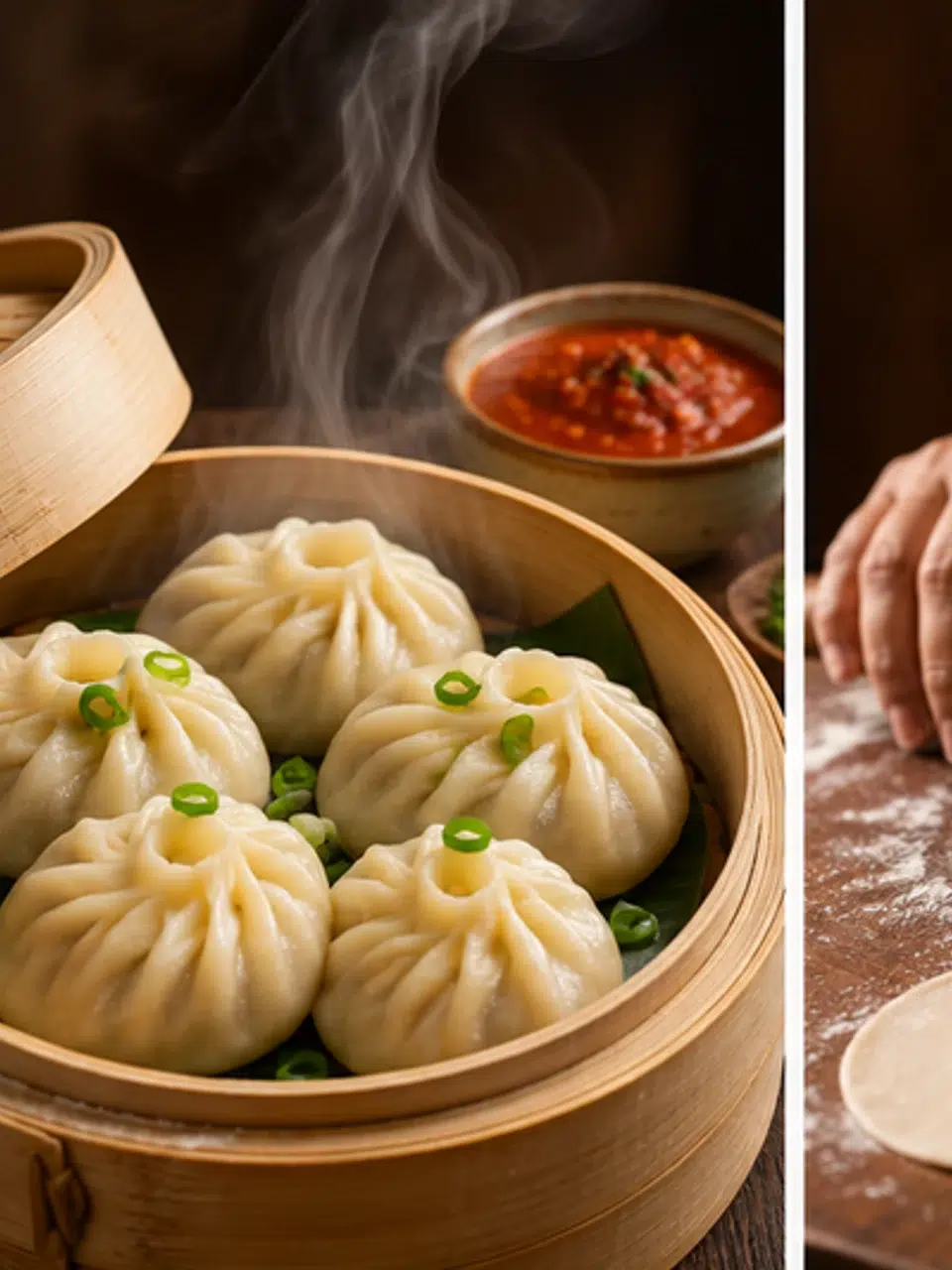
Steam cooking and hot-air cooking are physically different. Steamed momo wrappers usually stay tender and moist, while air-fried wrappers can become crusty at the edges. If you prefer the softness of a classic steamed dumpling, a dedicated steamer or a stable raised tray in a covered pot may be the better choice.
Fresh, Refrigerated and Frozen Momos: Not the Same Timing
| Starting point | Recommended approach | What to check |
|---|---|---|
| Fully cooked, recently steamed veg momos | Light oil; air-fry briefly for crisping | Wrapper not overly dry, filling hot throughout |
| Fully cooked, refrigerated veg momos | Use a little more time as needed; don’t stack | Heat through to a safe leftover-reheating temperature |
| Commercial frozen momos | Follow the package directions if they include air-fryer cooking | Whether they are precooked or raw and the filling’s safe temperature |
| Raw chicken-filled or raw mixed-meat momos | Do not use the brief crisping recipe above | Food thermometer; poultry must reach 74°C (165°F) at centre |
Different published sources demonstrate the variation. On the Flame describes air-frying already steamed momos at around 180°C for about ten minutes in its recipe. Hungry Healthy Happy gives a different shorter trial for frozen gyoza at 190°C. These are different dumplings and different appliances, not proof of one universal momo setting.
Detailed Instructions for Crispy Air Fryer Momos
Step 1: Verify that the filling is cooked
Read the packaging if you bought refrigerated or frozen momos, or confirm how your homemade batch was prepared. For this recipe, the starting momos must be fully cooked. A raw meat filling may not be safely cooked by a short crisping pass, even if the wrapper appears golden.
Step 2: Check the air-fryer basket and manual
Use the basket and rack intended for your appliance. Avoid unapproved plates, loose lightweight parchment or a water-filled bowl placed near electrical components. If the manufacturer instructs you to preheat, do so. Never block the fan or the air vents.
Step 3: Lightly oil the surface
Brush or spray a small amount of oil over the momos. This can reduce excessive surface drying and assist browning. The required quantity depends on wrapper texture and fryer capacity, so start lightly. A heavily oiled dumpling defeats the purpose of choosing an alternative to deep-frying.
Step 4: Leave room between the momos
Lay them upright in one layer, avoiding a crowded stack. Smaller air fryers may need two batches. Overcrowding makes heating uneven and reduces airflow. The final shape also matters; thick pleated crowns may brown differently from flatter folded sections.
Step 5: Check the colour and texture early
Try around 180°C. Inspect after approximately five minutes and turn using tongs if necessary. Continue in short increments if the surface still feels damp. Stop before the wrapper becomes hard or brittle. Actual times vary by whether you start hot, chilled or frozen, how large the dumplings are and how your model circulates heat.
Step 6: Confirm the centre and serve
Cut a sample open or use a suitable thermometer for temperature-sensitive fillings. For reheating previously cooked leftovers, US food-safety guidance recommends 74°C (165°F) at the centre. Serve immediately with sauce rather than leaving food warm in an unattended switched-off appliance.
Can You Put Raw Momos Directly in an Air Fryer?
Some published recipes make raw dough-wrapped dumplings directly in an air fryer, but this requires a method tested for the wrapper, filling, size and appliance. For delicate momo dough, the wrapper can dry out before the filling cooks fully. The guide here avoids that uncertainty by starting with fully cooked vegetable dumplings and using hot air only for surface crisping.
If your starting product has raw poultry, do not assume an air-fryer timer alone makes it safe. Use validated product instructions and measure the centre as needed. A safe poultry minimum is 74°C (165°F); different raw meats have their own requirements.
How to Air Fry Frozen Momos Safely
First identify whether the frozen momos are precooked or raw. A package labelled ready to cook is not necessarily already cooked. When the manufacturer provides air-fryer instructions, follow those. If the product has no such instructions, steaming according to its label may be safer than improvising air-fryer time and temperature, especially for raw meat fillings.
A frozen item may brown on the outside well before the centre is adequately heated. Do not judge doneness solely by a crisp wrapper. For home-prepared batches, see our guide to freezing uncooked momos, which explains tray-freezing, packaging and temperature control.
Why Are My Air Fryer Momos Hard, Dry or Uneven?
| Problem | Possible reason | What to change |
|---|---|---|
| Wrapper feels hard or leathery | Overcooking or insufficient surface moisture | Check earlier, apply a very light oil coating and reduce cooking time |
| Uneven browning | Overcrowding or differing momo sizes | Leave gaps and turn halfway |
| Inside still cold | Starting from chilled/frozen or using large momos | Continue heating carefully and check the centre |
| Momos stick to basket | Very wet wrapper or unprepared surface | Use a light approved oil coating and remove carefully |
| Crust is not crispy | Too much surface moisture or crowded basket | Dry surface gently, space pieces and cook in short increments |
| Filling leaks | Poor seam, overfilled wrapper or tears | Start with intact, fully cooked momos and handle gently |
Air Fryer vs Steam vs Deep Fry: Which Is Best?

Steam is a good choice for soft, tender wrappers and little added cooking oil. Air-frying provides a crisper surface without immersing the dumplings in a pan of oil, but may produce a drier wrapper. Deep frying delivers another crisp texture and can increase oil uptake. No method alone tells you the exact calories without ingredient weights and preparation data.
Our steamed vs pan-fried momos comparison discusses these differences in more detail. The Momo Crown menu provides examples of steamed, fried and pan-fried styles, though this educational air-fryer method is not represented as the kitchen procedure for any branded menu item.
Safety and Temperature Guidance
For reheating cooked leftovers, FoodSafety.gov lists a target of 74°C/165°F. Refrigerate perishable food at 4°C or below within two hours of cooking or service, or within one hour if the temperature is above 32°C. Keep the air fryer clean and don’t leave hot food unattended.
If the product contains raw poultry, poultry safety rules apply regardless of whether you steam or air-fry it. Do not assume that an illustration, cooking-time chart or crispy outside proves a safe centre.
Choose an Air-Fryer Method Based on the Starting Momo
Freshly cooked steamed momos: These are an easy starting point for a crisp finish. Let surface moisture evaporate, brush lightly with oil and spread dumplings apart in the basket. The filling is already cooked, so the goal is to gently crisp the outside while serving it properly hot. Watch the thin pleats because they can dry and darken faster than the middle.
Chilled cooked leftovers: Thorough reheating matters more than browning. A golden crust can hide a cool filling. FoodSafety.gov recommends reheating leftovers to 74°C (165°F). If the wrapper is unusually dry, a short covered steam before a brief air-fryer finish may give a better result. Never use this method to rescue food left at room temperature too long.
Fully cooked frozen momos: Check whether the packaging actually says fully cooked. Start with the product’s directions, where available. The centre will take longer to warm than a fresh dumpling, and an aggressively hot air fryer may dry the wrapper before the middle is properly reheated. A steam-first approach may work better for fragile wrappers.
Raw frozen momos: Do not treat a brief crisping pass as complete cooking. Raw meat or poultry requires a validated cooking process and safe temperatures; raw poultry fillings must reach 74°C (165°F) internally. Read our guide to cooking frozen momos to distinguish raw cooking from reheating.
Basket Setup, Oil and Appliance Safety
Follow your specific air fryer manual for preheating, accessories and whether the basket needs oil. Do not place loose parchment into an empty preheating basket, where circulating air may lift it into the heating element. Do not improvise a steaming function by putting water in an electrical air fryer that does not permit it. Choose approved accessories and leave the air vents clear.
Arrange the momos in one layer with space between them. Overcrowding prevents even circulation and leaves some pieces soft while exposed edges become too dark. Lightly spray or brush with oil, but do not saturate the wrapper. A thick coat of oil will not correct a cold filling, and one trial temperature cannot work exactly the same for every appliance.
Turn dumplings carefully after the first inspection and continue in short increments rather than adding a long second cycle without checking. Thin edges may become brittle if exposed to high heat too long. Place the hot basket on a heat-safe surface, keep children away from hot air and handle finished dumplings with suitable utensils.
Serve air fryer momos soon after cooking with dipping sauce on the side. A wet sauce can soften a crisp coating quickly. If the food is becoming hard instead of pleasantly browned, stop and choose a gentler method rather than continuing to heat it solely for colour.
Build a Meal Around Crisp Air Fryer Momos
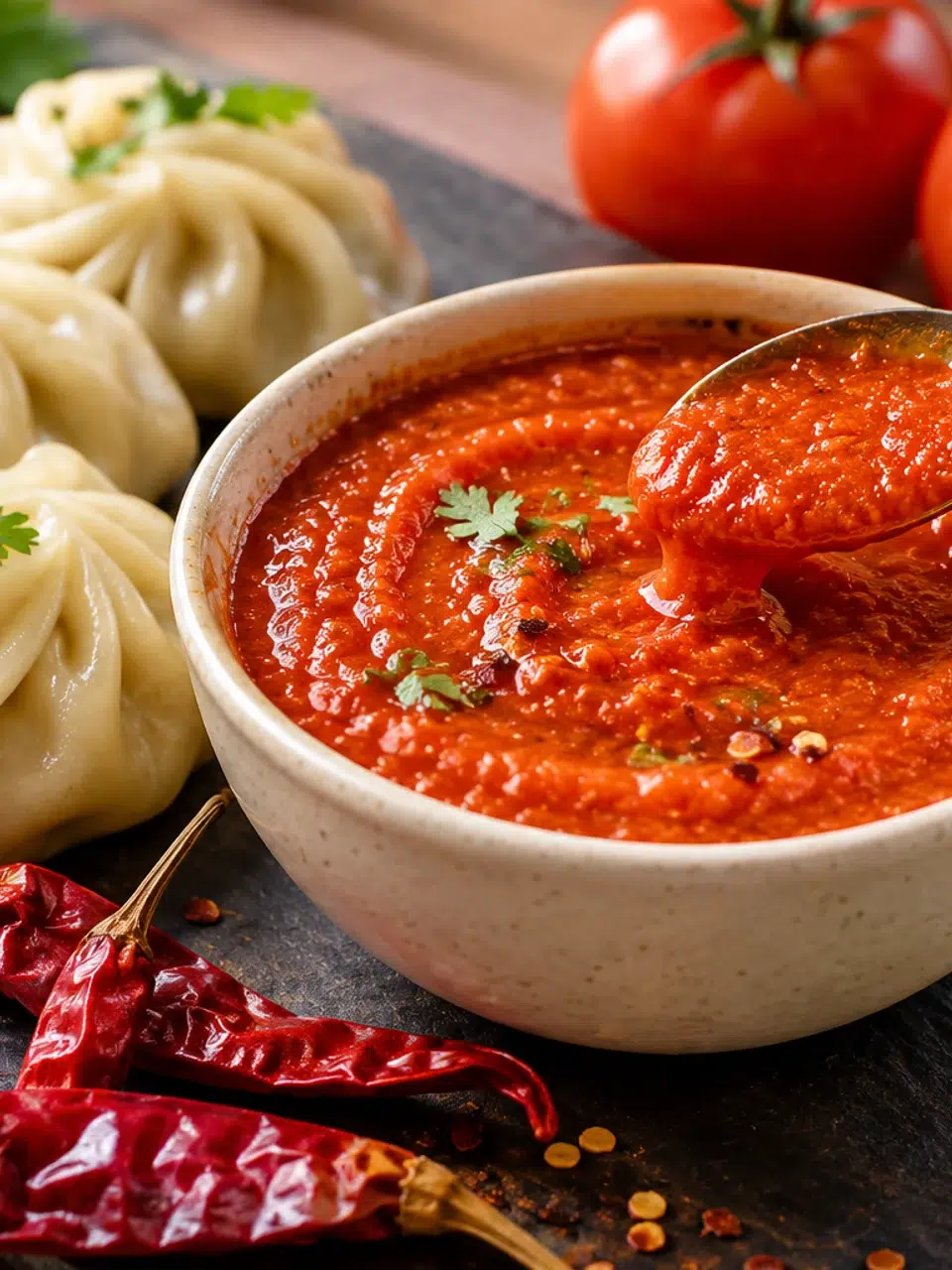
A crisp momo works well with a bright tomato-based dipping sauce, a small vegetable side or a light broth served separately. Try our garlic-free tomato-chilli chutney for a tangy contrast, or offer a mild tomato-ginger sauce when guests prefer less heat. Put stronger dips in separate labelled bowls instead of coating everyone’s dumplings at once.
Choose portions based on the role of the dish. A small plate of crisply finished vegetable momos may be a snack; a larger dinner can include cooked vegetables and a suitable side. For an allergy-aware meal, check wheat in the wrapper, milk in paneer, soy in seasonings and sesame or peanuts in dipping sauces. Frying or air-frying does not remove these ingredients.
If you are hosting, prepare only a manageable batch at a time and serve it promptly. Label different fillings, keep raw and cooked ingredients separate and refrigerate appropriate leftovers quickly. Our party checklist covers shared utensils, sauces and food holding.
For the base dumpling, begin with our vegetable momo recipe and cook it completely before air-frying. This prevents confusion between making raw dumplings safe and adding a crunchy outer finish to food that was already cooked.
Four Air-Fryer Momo Troubleshooting Examples
Hard wrapper, cool centre
The outside heated faster than the filling. Check the product’s raw or cooked status and use an appropriate complete cooking or reheating process. Do not use a golden colour as a safety test.
Pale or uneven browning
A crowded basket or uneven surface moisture can prevent a consistent crust. Space out the pieces, turn them gently and check in shorter intervals. Adding excessive oil is not a reliable fix.
Dark pleats, tender middle
Thin exposed tips crisp faster. Lower unnecessary exposure and consider a short crisping finish after thorough steaming rather than using hot air for the entire cooking process.
Soggy after adding sauce
Wet chutney softens crisp surfaces. Keep the dip on the side and coat only the piece being eaten. A saucy broth bowl can also be enjoyable, but it is a different texture from a crisp air-fryer momo.
The common thread is to match the method to the starting product. Temperature and cooking time are kitchen variables; thorough cooking, safe storage and the appliance instructions remain essential.
Frequently Asked Questions
Can you make momos crispy in an air fryer?
Yes, especially with already cooked small dumplings, a light oil coating and a short hot-air crisping stage. Texture depends on your appliance and wrapper.
What temperature should I try first?
About 180°C is a reasonable starting trial for fully cooked veg momos; inspect early and adjust based on the result. It is not a tested universal setting.
How long do frozen momos take in an air fryer?
There is no single duration. Product status (raw or precooked), thickness, size and device make a substantial difference. Follow package instructions when available.
Can you steam momos in an air fryer?
An ordinary air fryer primarily uses hot moving air, not a dedicated steam chamber. A model with a manufacturer-approved steam function may work differently. Do not place improvised bowls of water into electrical equipment unless the manual permits it.
Do air-fried momos have fewer calories?
They may use less cooking oil than deep-fried versions of the same dumplings, but exact energy savings cannot be claimed without measuring both recipes and portions.
Can I air-fry paneer momos?
Already cooked paneer momos can be gently crisped, but the dairy filling and wrapper may dry if cooked too long. Reheat thoroughly and check the centre.
Sources and further reading
Use these cooking and safety resources alongside your air fryer manual; exact results depend on the food and appliance.
- On the Flame: Air-Fried Vegetable Momo Manchurian — one method starting from steamed momos.
- Hungry Healthy Happy: Air-Fryer Gyoza — a separate frozen-dumpling approach with appliance-specific timing.
- FoodSafety.gov: Safe Minimum Internal Temperatures — leftover and poultry temperature checks.
- FoodSafety.gov: 4 Steps to Food Safety — food handling, chilling and reheating principles.